


Introduction
In a world where digital currencies are becoming mainstream, the term cryptocurrency mining often piques curiosity. How can a virtual coin, devoid of physical form, be “mined” like gold? The answer lies in complex algorithms, blockchain technology, and the growing global interest in decentralized finance. This comprehensive guide aims to demystify cryptocurrency mining for beginners, providing an in-depth, step-by-step breakdown of the process, recent statistics, success stories, and critical questions for debate.
Did You Know?
- As of 2024, the global cryptocurrency mining market is valued at $4.5 billion and is expected to grow at a CAGR of 7.4% through 2028.
- Over 80% of Bitcoin mining happens in countries like the United States, China, and Russia, highlighting its global reach.
Let’s delve deeper into what cryptocurrency mining is, its benefits, and how you can begin your mining journey today.

1. What is Cryptocurrency Mining?
Cryptocurrency mining is the process of validating and recording transactions on a blockchain network. In return for contributing their computational power, miners are rewarded with newly minted cryptocurrency coins.
Think of cryptocurrency mining as a decentralized ledger system where miners compete to solve cryptographic puzzles. Solving these puzzles requires immense computing power and energy, but success ensures:
- Verification of transactions to maintain network security.
- Introduction of new coins into circulation.
Key Concepts in Mining
- Blockchain: A digital ledger that records transactions chronologically and securely.
- Proof of Work (PoW): A consensus mechanism where miners solve puzzles to verify blocks.
- Hash Rate: The speed at which a mining rig completes calculations.
- Mining Rewards: Coins awarded to miners for validating blocks.
Visual Explanation: How Mining Works
Consider using a simplified flowchart or infographics to showcase this process:
- Transactions are initiated.
- Miners compete to solve a cryptographic puzzle.
- The first miner to solve it validates the block.
- The validated block is added to the blockchain.
- The miner receives a reward.

2. Types of Cryptocurrency Mining
There are several methods of cryptocurrency mining, each with varying levels of complexity, cost, and profitability.
A. Solo Mining
- What It Is: Mining independently using personal hardware.
- Pros: Full rewards go to the miner.
- Cons: Requires significant computing power and high energy costs.
- Example: Early Bitcoin miners used personal computers for solo mining in 2010.
B. Pool Mining
- What It Is: A group of miners combine their resources to increase their chances of solving a block.
- Pros: Higher probability of earning rewards.
- Cons: Rewards are shared among pool members.
- Example: Pool mining contributes to over 70% of Bitcoin’s hash rate.
C. Cloud Mining
- What It Is: Renting mining power from third-party providers.
- Pros: No need to purchase hardware.
- Cons: Potential for scams and lower profitability.
- Example: Providers like Genesis Mining offer cloud-based solutions.
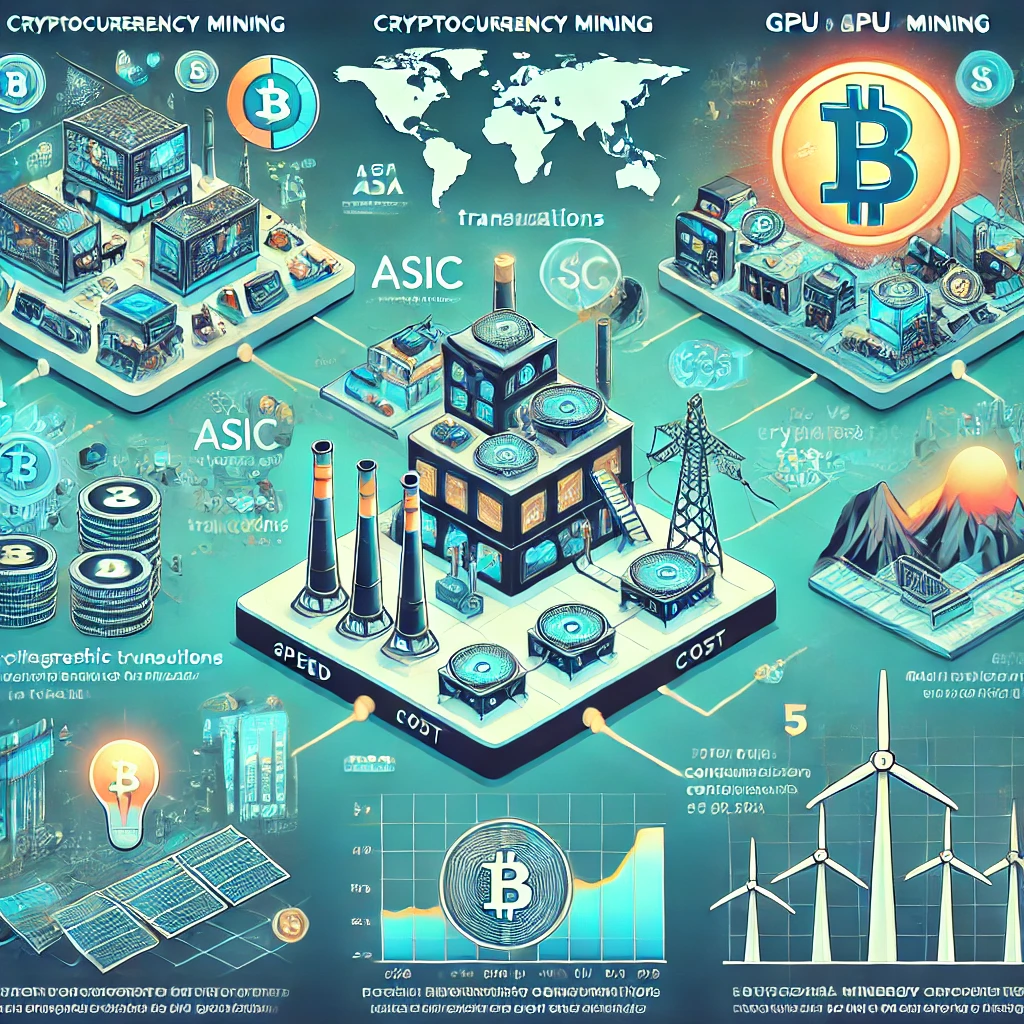
D. ASIC vs. GPU Mining
| Factor | ASIC Mining | GPU Mining |
|---|---|---|
| Speed | Extremely fast | Moderate |
| Cost | Expensive hardware | More affordable |
| Use Case | Bitcoin, Litecoin | Ethereum, altcoins |
| Flexibility | Limited to specific coins | More versatile |
3. Step-by-Step Guide to Start Mining
Step 1: Choose Your Cryptocurrency
Before starting, decide which cryptocurrency you want to mine. Bitcoin (BTC), Ethereum (ETH), and Litecoin (LTC) are popular choices, but newer coins can offer greater profitability.
Did You Know? In 2023, Bitcoin mining accounted for 900 new BTC daily, with each block mined yielding 6.25 BTC.
Step 2: Select Your Mining Hardware
- ASIC Miners: Best for Bitcoin but expensive.
- GPUs: Affordable and versatile for altcoins.
- CPUs: Least powerful, used for beginner-level mining.
Step 3: Choose Mining Software
- Popular Options:
- CGMiner (Command-line-based software).
- NiceHash (Beginner-friendly software).
- EasyMiner (Great for Windows users).
Step 4: Set Up a Wallet
To store your mining rewards, you need a secure cryptocurrency wallet. Popular wallets include:
- Hardware Wallets: Ledger Nano X, Trezor.
- Software Wallets: Trust Wallet, Exodus.
Step 5: Join a Mining Pool
Combine your computational resources with others to increase block validation chances. Top pools include:
- Slush Pool
- F2Pool
- Binance Pool
Step 6: Monitor and Optimize
Use tools like MinerStat or Hive OS to track your mining performance and adjust settings for maximum profitability.
4. Real-Life Success Stories: Mining Triumphs
Case Study 1: The Story of John McCarthy
John McCarthy, a small investor, turned a $1,500 investment into $100,000 within two years by focusing on Ethereum mining in its early days. By reinvesting profits into better GPUs, he scaled his operations and optimized energy consumption.
Case Study 2: Mining Farms in Kazakhstan
Kazakhstan became a global mining hub after China banned crypto mining in 2021. Companies moved operations to Kazakhstan, where energy costs were low. Today, the country contributes over 6% of Bitcoin’s global hash rate.
Key Takeaway
Success in mining requires timing, strategy, and the ability to scale operations.
5. Environmental Impact of Mining: A Controversial Debate
Cryptocurrency mining consumes vast amounts of energy, leading to heated debates.
- Fact: Bitcoin mining alone uses 120 TWh of electricity annually, comparable to the energy consumption of small countries.
- Question: Is cryptocurrency mining worth the environmental cost, or do its benefits outweigh the negatives?
Solutions for Sustainable Mining
- Adoption of renewable energy (solar, hydro, wind).
- Innovations in energy-efficient hardware.
6. Key Statistics and Industry Trends
- Global Mining Revenue: Expected to hit $20 billion by 2026.
- Top 3 Countries for Mining: USA (37.8%), China (21%), Kazakhstan (6%).
- Energy Use per BTC: Approximately 707 kWh.
Conclusion
Cryptocurrency mining offers a unique opportunity to earn digital assets while supporting blockchain networks. While it has challenges—from high energy consumption to volatile rewards—understanding the process and using the right strategies can unlock significant potential.
Thought-Provoking Question: As cryptocurrencies evolve, will traditional mining fade in favor of greener, more efficient consensus mechanisms like Proof of Stake (PoS)?
FAQs
- Is cryptocurrency mining legal?
- Yes, but regulations vary by country.
- How much can I earn as a beginner?
- Earnings depend on the hardware, cryptocurrency, and energy costs.
- Is mining still profitable in 2024?
- Yes, especially with efficient hardware and cheaper energy sources.
- What is the best coin to mine for beginners?
- Ethereum Classic (ETC) and Ravencoin (RVN) are beginner-friendly.
- How do I minimize energy costs?
- Use renewable energy or locate your rigs in regions with low electricity costs.